
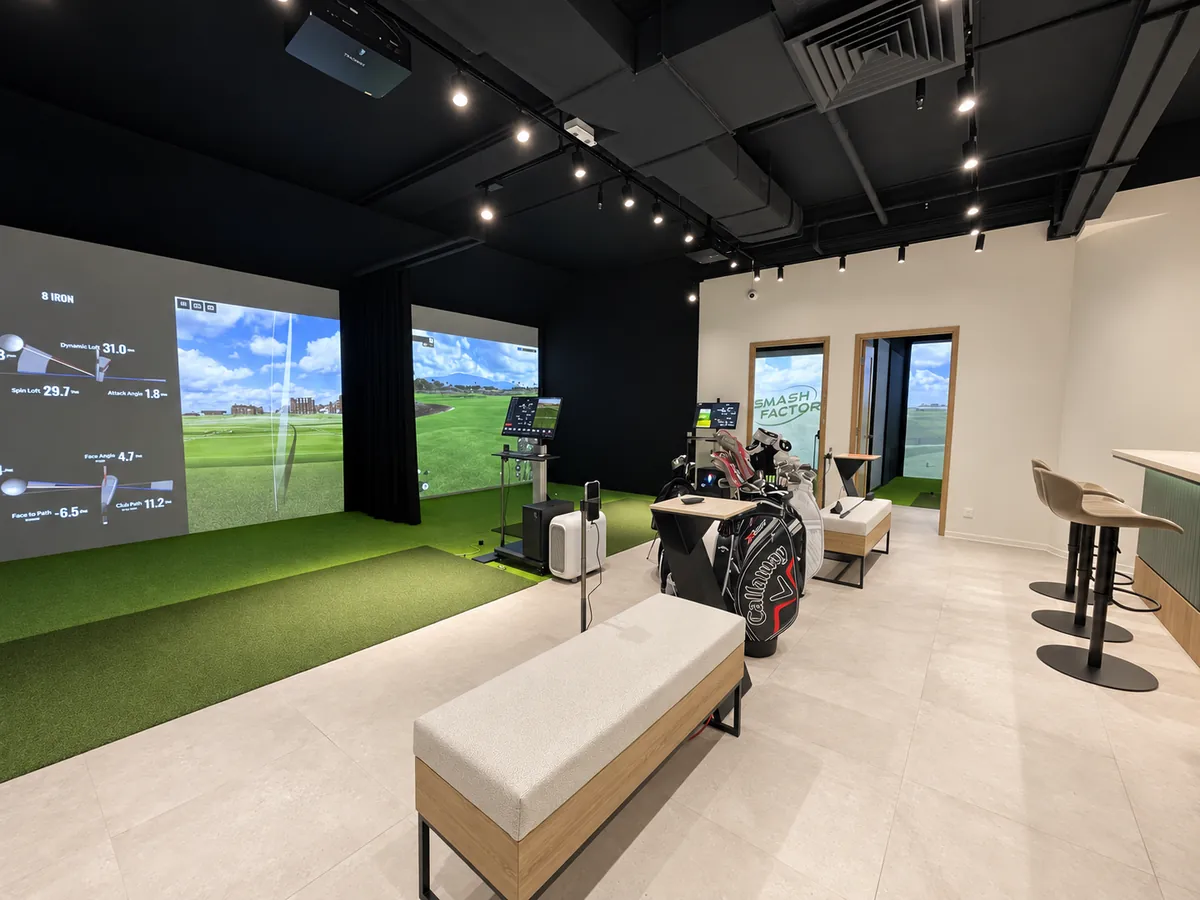
Indoor golf lets you hit real golf balls with real clubs while a simulator displays the result. You can practise individual shots, play a virtual course or take a lesson, depending on what you book.
At Smash Factor, visitors often tell us they are surprised by how much they can do beyond hitting balls at a screen. A walkthrough makes the options easier to understand: compare a swing on video, try a different target on each shot, or play a few virtual holes.
You do not need to learn every feature on your first visit. Start with what you want from the session, then choose the tools that help.
How does indoor golf work?
You hit from a designated area into an impact screen. A launch monitor gathers shot information, and the software uses it to calculate and display the ball’s flight. Indoors, the ball stops at the screen; the rest of the flight shown is simulated.
Different systems use different tracking methods. Smash Factor uses Trackman 4, which combines radar and camera technology to provide club and ball data. All five bays also have separate swing cameras for reviewing your movement. Trackman explains its launch-monitor technology here.
The data and video answer different questions. Shot data helps you understand the result and what happened around impact. Video lets you see the movement that produced it. Neither requires you to study every number after every shot.
Should you practise, play a round or book a lesson?
Decide what you want to do before booking. These sessions can use the same equipment, but they serve different purposes.
| Your aim | A useful starting point |
|---|---|
| Understand your usual distance or shot pattern | Practise with one familiar club and review several shots together. |
| Test how you handle different targets | Try a target-based practice mode such as Performance Center. |
| Play solo or spend time with friends | Choose a virtual course and agree on the round settings. |
| Learn to swing or work on a movement with guidance | Explore our golf lesson programmes and book a lesson with a coach. |
A bay rental does not automatically include coaching. If you are completely new to golf, our beginner’s guide to indoor golf lessons explains what instruction involves and how to prepare.
Which Trackman features are useful on a first visit?
The feature list matters less than understanding what you can use it for. These are three examples we show visitors at Smash Factor.
Shot analysis: find your usual result
Start with a question such as: “How far does this club normally carry, and how spread out are my shots?”
Carry describes flight distance before roll; Trackman’s definition uses the point where the ball returns to its launch elevation. Total includes the calculated roll to the resting position. Keep that distinction in mind when comparing shots or choosing a club. See Trackman’s parameter definitions.
Look at several shots, including the less successful ones. Your longest shot tells you something different from the distance and direction you can usually produce. If the shots keep finishing short, left or right, that gives you a more useful question to investigate than simply trying to beat your best number.
Swing replay: connect what you feel with what you do
At Smash Factor, you can review your swing from two angles and compare it side by side with a tour-player reference. Visitors often find this useful because a movement becomes easier to understand when they can see it.
Choose one thing to observe, such as how the body turns during the backswing. A comparison can reveal a difference worth discussing; it does not mean you need to copy every position in another golfer’s swing. If you are unsure what a difference means, a coach can help connect the movement with your shot pattern.
Performance Center: change the target, then assess the shot
Hitting towards the same target repeatedly is one way to practise. Performance Center also lets you work within a chosen distance range with targets presented in random order.
It provides strokes-gained feedback after each shot against a selected benchmark. In plain language, this shows whether the result gains or loses strokes relative to that reference. It is feedback on the shot, not a promise about your next course score. Trackman’s Performance Center guide explains the settings.
This gives you a reason to pause, choose a club and decide what shot to play. You can then review whether your misses tend to be short, long or to one side. You do not need to begin with the toughest benchmark to make the session useful.
What is it like to play a virtual golf course?
You choose a course, hit real shots and follow the simulated ball to the next position. You can play solo or take turns with friends. At Smash Factor, visitors also comment on the course graphics; every bay has a 4K projector.
Before starting, check the tees, scoring format and putting settings. Trackman offers automatic-putting options that assign putts according to the selected mode, which changes how the round is played. Read Trackman’s explanation of automatic putting.
Do not assume a group will finish 18 holes in the time it takes one person. Player numbers, experience, settings and time spent between shots all affect the pace. Tell the venue whether you want a full round or a relaxed session before choosing your booking length. Playing a few holes is a reasonable first visit too.
How does indoor golf compare with outdoor practice?
Indoor golf offers a sheltered place to practise and review feedback. Outdoor golf adds experiences that a simulator does not fully reproduce. Both can have a place in your routine.
| Indoors, you can focus on… | Outdoors, you also experience… |
|---|---|
| Repeating a shot from a consistent hitting surface | Changing lies, slopes and contact with natural turf |
| Reviewing shot data alongside swing video | Watching the ball’s flight and landing in the actual environment |
| Choosing virtual targets and course situations | Wind, real green surfaces and moving around a course |
A good indoor session can help you identify something to work on. Taking that learning outdoors gives you a chance to apply it in different conditions. An indoor score or distance should not be treated as a guaranteed outdoor result.
How should you prepare for your first session?
Wear comfortable clothing that lets you turn and bend, with stable sports shoes. Bring your clubs if you have them, or arrange rental beforehand. You do not need to buy a set just to try indoor golf.
Before booking, confirm:
- Your purpose: independent practice, virtual play, an introduction or a coached lesson.
- Your group: how many people will play and which bay or room suits them.
- Your equipment: whether you need rental clubs and what they cost.
- Your setup: how to enter, start the session and get help if needed.
Once you arrive, get familiar with the hitting area and controls before starting. Keep other people clear of the golfer’s swing, including practice swings. Warm up, then begin with a familiar club and one simple task.
For a first practice session, that could mean checking your usual distance with one club, reviewing a few swings, then trying a changing-target challenge. This is a suggested starting point, not a programme you need to complete. Leave time to note what you learned and what you would like to practise next.
What does indoor golf at Smash Factor cost?
You can book as a visitor without joining a membership. If you plan to practise regularly, compare the member rates too. Membership costs HK$2,680 for 12 months, with sessions charged separately as you book.
Hourly prices are per bay or room, with the stated number of golfers included.
| Space | Golfers included | Members per hour | Visitors per hour |
|---|---|---|---|
| Open bay | 1 | HK$150 | HK$350 |
| Private room | 2 | HK$200 | HK$450 |
| VIP room | 3 | HK$250 | HK$550 |
Additional golfers beyond those included cost HK$50 each per hour at member rates, or HK$100 at visitor rates. Private and VIP room minimum charges apply even if fewer golfers attend. Club rental is free for members and valid lesson-pass holders; other visitors pay HK$100 per set per session.
For example, one visitor booking an open bay for an hour and renting one set of clubs would pay HK$450 total: HK$350 for the bay plus HK$100 for the clubs. Coaching is a separate booking.
For an existing member, the same one-hour open-bay session costs HK$150, with club rental included. The annual membership fee is separate, so consider how often you expect to visit when comparing overall costs.
All five bays have Trackman 4, dual-angle swing replay and 4K projection. Choose your space around privacy and group size; the core setup is the same. Explore our bays and rooms and check current rates and member or lesson-pass options.
Visitor sessions are usually available from 10am to 10pm, by booking only. Members and valid lesson-pass holders have 24/7 access for booked sessions during their membership or pass validity. This does not mean a coach or member of staff is present around the clock. Message us to arrange a visitor session.
Want to understand the features before booking practice?
Our free 30-minute introduction is by appointment at Smash Factor in Kwun Tong. You can try Trackman, explore the studio and see how the feedback and practice options work.
In our experience, walking someone through a feature is more useful than showing them a long list of capabilities. Bring a question about your own game, or tell us you are completely new, so we can show you a relevant starting point. The introduction is not a full coached lesson.