
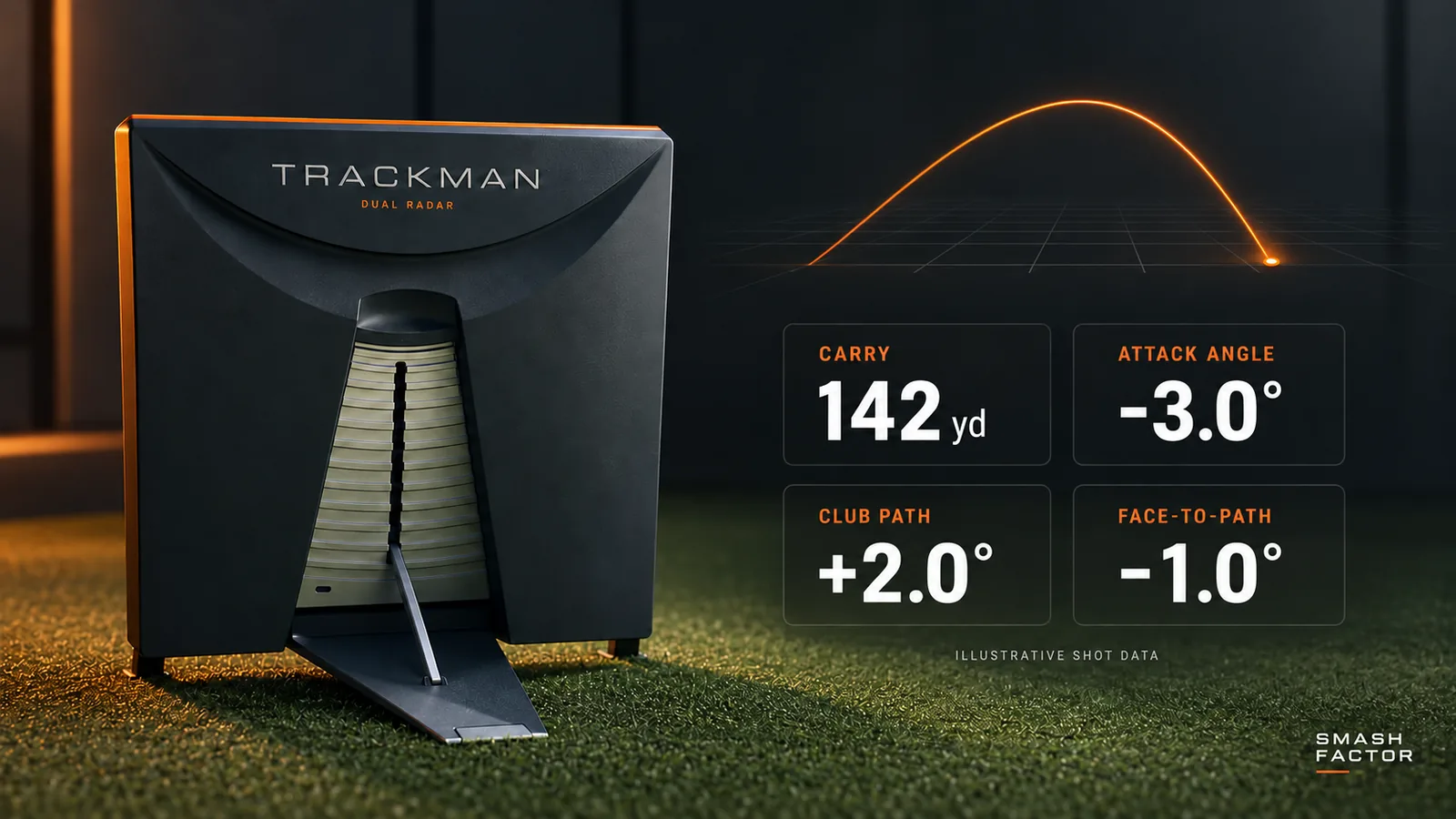
You hit one shot that feels good, then another that goes somewhere different. When you are new to golf, it can be hard to understand what changed.
Trackman helps you see and measure each shot. It shows how far the ball travels, where it goes and how the club moves as it hits the ball. That gives you feedback to compare with what you felt during the swing.
You do not need to understand every number. Start with a few basics and learn more as they become useful.
How does data make practice more useful?
Without feedback, it is easy to keep hitting balls and hope the next one is better. With data, you can notice differences and begin asking useful questions.
Did a shorter swing send the ball a shorter distance? Did the ball finish nearer your target? When a coach helped you change a movement, did the result change too?
At Smash Factor, we want golfers to build that connection between movement, feeling and result. The numbers make changes easier to compare. Swing replay lets you see the movement as well. Over time, these can help you understand your own swing more clearly.
Start with distance, direction and a few shots together
For your first session, focus on three simple things:
- How far did it fly? Look for Carry. On a flat practice range, think of it as the distance through the air, before the ball rolls. This helps you learn the distances you normally hit with each club. Trackman’s Carry guide.
- Where did it go? Watch the ball flight and where it finishes compared with your target. Is it usually left, right or somewhere different each time?
- How similar are your shots? Look at several shots together. If most finish near one another, you are starting to build a repeatable result. Include your normal misses, rather than keeping only your best shot.
You already have something useful to work with, even before looking at the more detailed numbers.
Connect what you feel with what you see
Try a simple comparison with a club you feel comfortable using. Make a shorter swing for a few shots, then your usual comfortable swing. Notice the difference in how they feel, then compare the distances on screen.
Does the shorter swing regularly produce a shorter shot? Are the results similar when you repeat it? Watch the replay if one shot feels different from the others.
This is how data becomes useful: you start recognising a feeling and seeing the result that goes with it. One shot will not explain everything, so look for a pattern across several attempts.
Add a little more detail when you are ready
Once the basic feedback feels familiar, these three terms can help you learn more about the club:
- Attack Angle: whether the club is moving down or up when it hits the ball.
- Club Path: the direction the club is travelling as it hits the ball.
- Face-to-Path: where the clubface points compared with that direction. This helps explain why the ball curves.
You can explore these one at a time with a coach. For example, when working on how you move through a swing, the data helps you check whether the club’s movement changed too. It does not explain every body movement by itself.
You do not need to memorise angles or chase a professional’s numbers. Learn what a number describes, connect it with your shots, then build from there. Trackman’s introduction to basic golf data and Face-to-Path explanation offer more detail when you want it.
Give your next practice session one focus
Choose one club and a comfortable target. Hit a small group of shots, notice how they feel and review the results together. Keep the club, ball type and settings the same while comparing.
If your coach has given you a movement to practise, focus on that one instruction. Check what changes in the data and the ball flight, rather than trying to change everything at once.
Finish by noting one thing you learned. Next time, see whether you can repeat it. If the feedback is confusing, a golf lesson can help you understand it and choose a suitable next step.
Try Trackman with someone to show you where to start
At Smash Factor in Kwun Tong, every bay has Trackman 4 and dual-angle swing replay. During a free 30-minute introduction, you can hit some shots, see your feedback and learn how to get started with the system.